RESEARCH PROPOSAL · BEHAVIOURAL EXPERIMENT AND MODEL TEST
How does learning change the pleasure
of the same musical event?
Independent research proposal · Listening history, controlled learning and model validation
Abstract
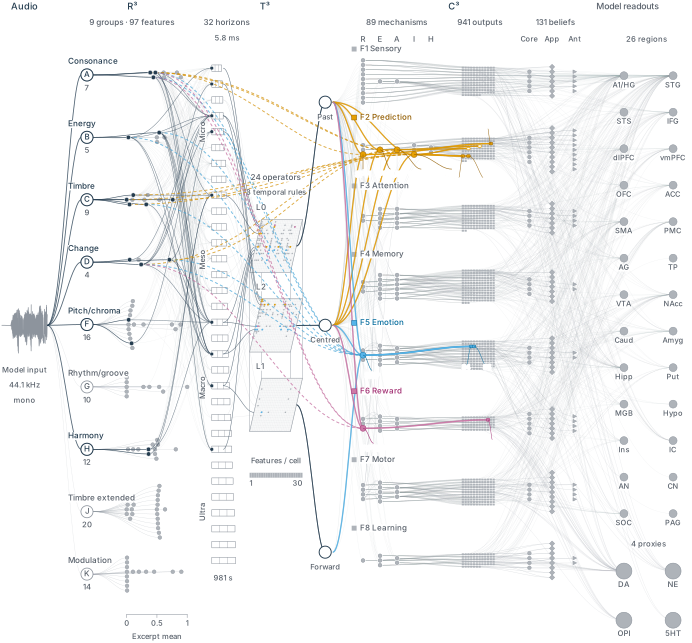
The same musical event may feel different after different listening histories. We will combine participant-provided listening records with Musical Intelligence (MI) features from verified recordings to estimate individual exposure profiles. Recognition and continuation tasks will test these estimates. A controlled experiment will then manipulate learned expectations while keeping test audio unchanged and measure pleasure. Separate comparisons will test whether history-informed MI adds predictive value beyond self-report, listening frequency and acoustic baselines. Exposure is treated as evidence about listening experience, not a direct measurement of memory.
1. The unresolved question
Research connects musical pleasure to surprise and uncertainty, but reports different directions of their interaction.1,2 Learning can also create preferences for unfamiliar musical structures.3 We ask how measured listening experience and experimentally learned context relate to the response to an unchanged musical event.
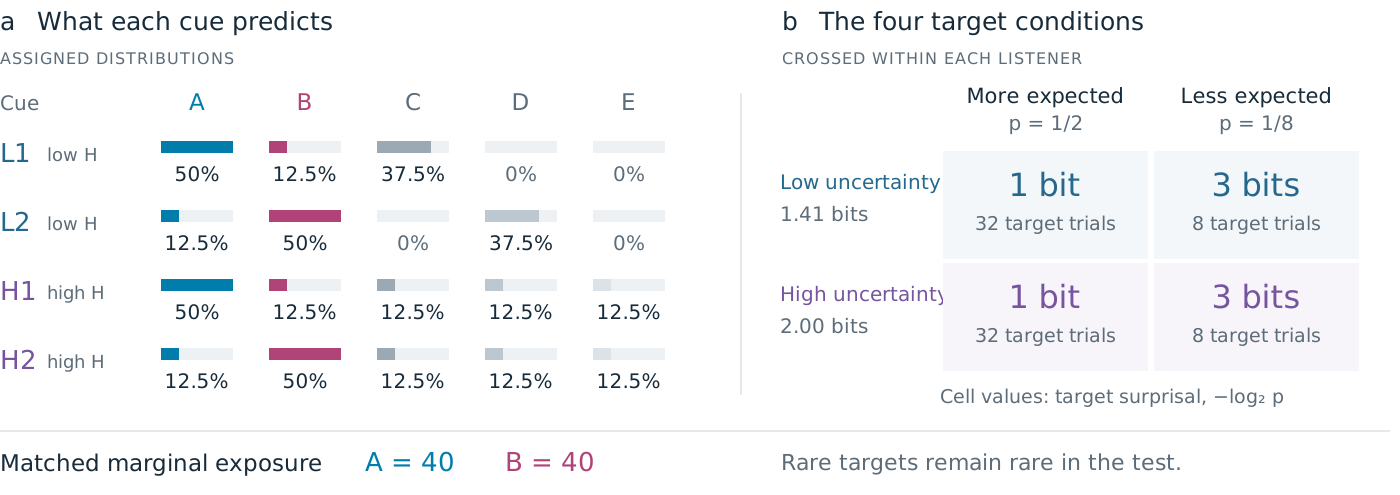
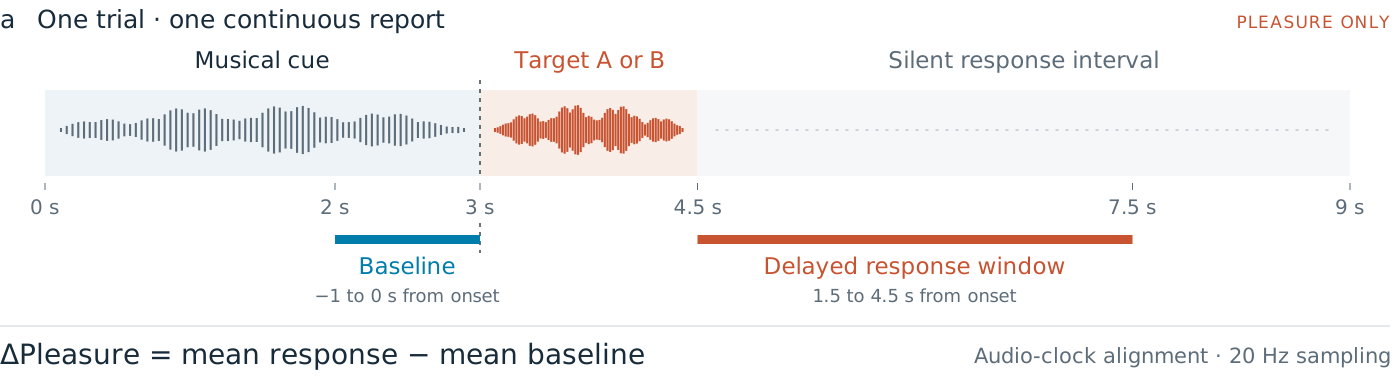
We will manipulate the probability of two target continuations and the uncertainty of the cue that precedes them. Cue meanings will be counterbalanced across listeners. Thus, an identical cue–target recording can have different learned meanings without changing its waveform.
2. Two distinct tests
H1. Contextual uncertainty changes the difference in pleasure between less- and more-expected targets. The primary contrast is a difference of differences, tested in both directions.
H2 · Secondary. MI-derived exposure profiles improve held-out prediction of familiarity, expectation and pleasure beyond self-report and listening-history baselines. H1 tests experimentally assigned learning; H2 tests prediction from observed histories. Neither establishes a unique neural mechanism.
3. What is held constant?
Within each musical family, target A is the same audio file wherever it occurs; the same applies to B. Each target is heard equally often overall. Four cues assign A and B probabilities of either 1/2 or 1/8, under low or high uncertainty. Three other continuations preserve these distributions.
This separates conditional predictability from simple target familiarity. Cue acoustics and target identities are counterbalanced, with sequence and repetition effects included in analysis. Specific cue–target pair familiarity remains linked to probability and limits interpretation.
4. Scope and participants
The planning sample is 192 adult non-musicians, plus a separate pilot of 24. Twelve new musical families will be tested; each listener learns one. English comprehension, headphone screening6 and task practice are required.
Musical experience and reward sensitivity will be measured.4,5 History donation is optional; its absence does not exclude a listener from H1. H2 uses the consenting subset with usable records, with coverage and selection reported. Neither dopamine nor brain activity is measured.