MI-STM · MUSICAL INTELLIGENCE SPECTROTEMPORAL MORPHOLOGY
Can learned voice cues improve
speech recognition in noise?
Spectrotemporal profiling and individualized auditory training
Learning, perception and computational auditory research
Abstract
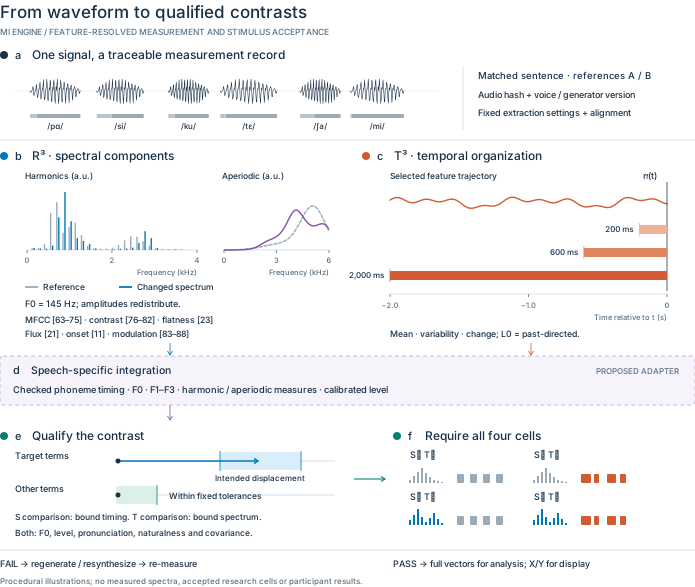
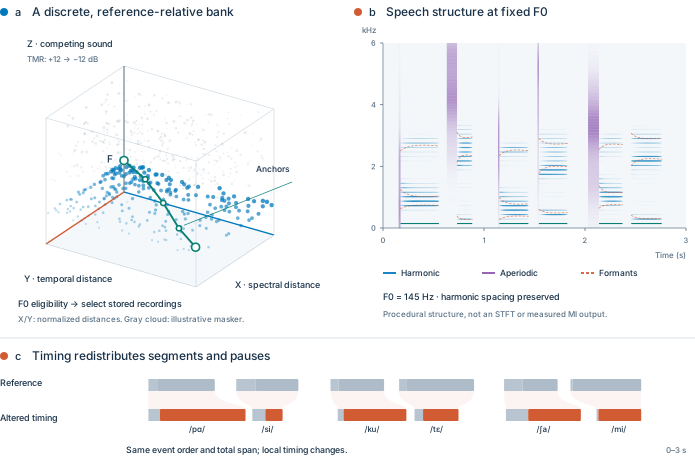
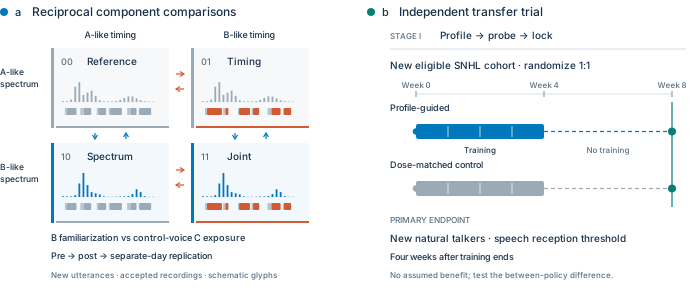
Familiar voices can improve speech recognition in noise, but this benefit does not identify which learned acoustic features are useful or how to train them. We propose a speech study in adults with sensorineural hearing loss. A measured bank of pre-generated utterances will support contrasts in spectral structure and segmental timing, with fundamental frequency constrained. Randomized familiarization, reciprocal component comparisons and separate-day replication will test learning-dependent cue use. A subsequent trial will compare profile-guided training with equally intensive control training. Its primary endpoint is recognition of new natural talkers four weeks after training. Clinical efficacy and the incremental predictive value of Musical Intelligence will be evaluated separately.
Keywords: speech-in-noise; talker learning; spectral envelope; temporal cue use; auditory rehabilitation
Explore the stimulus space
Drag to rotate. Move X, Y and Z to explore the same stimulus coordinates.
The live view loads here as you reach this figure.
1. Question and prior evidence
Which spectral and temporal features of a learned talker improve recognition when carried into new speech? Do their contributions combine additively or interact? Can that profile identify training targets that produce retained gains for previously unheard talkers?
Familiar-talker benefits have been demonstrated in older listeners with hearing loss.1 Laboratory familiarization can also improve intelligibility and reduce listening effort.2 These findings motivate learning as an intervention target; they do not establish which acoustic components produce the benefit.
Speech-cue weighting varies across listeners with hearing loss,3 and changing masker modulation shifts sentence-level spectral weights.4 A listener's profile is therefore conditional on the task and acoustic scene. The objective is better recognition, not equal spectral and temporal weights.
2. From music to speech
Originating in musical source selection, the proposal asks whether learned acoustic structure helps listeners follow a target amid competition. Speech makes that benefit directly measurable as word recognition; transfer from music training is not assumed.
3. Testable hypotheses
H1 · Learned component use. Familiarization changes the contribution of at least one prespecified spectral or timing contrast beyond matched exposure to a control voice. Both adding a B-like component to A-like speech and replacing it in B-like speech are tested.
H2 · Joint dependence. Familiarization changes the spectral × timing interaction. Its sign is not prescribed; a null result is informative only if uncertainty excludes a prespecified meaningful interaction.
H3 · Retained transfer. A frozen profile-guided selection policy improves speech reception threshold for new natural talkers four weeks after training, relative to a dose-matched active policy.
4. Research approach
Spectral-weighting methods provide a direct measurement precedent.4 A rhythm/EEG preprint links target/background timing to recognition and neural tracking.5 The proposed bridge is to ask whether learned component use predicts trainability and retained transfer.
The project combines auditory assessment, learning experiments and computational modelling to relate individual cue use to speech recognition.
| Evidence | What it supports | What remains to be tested |
|---|---|---|
| Familiar-talker benefit1,2 | Recognition depends on experience | Which learned components contribute? |
| Context-dependent cue weights3,4 | Cue use varies with listener and scene | Is the learning-related profile repeatable? |
| Targeted auditory practice6 | Task-level gains are possible | Does profile-guided practice transfer? |